Models that show their work.
One architecture for text, images, audio, 3D and sensor data. Every answer comes with its reasoning, its uncertainty and a record you can replay.
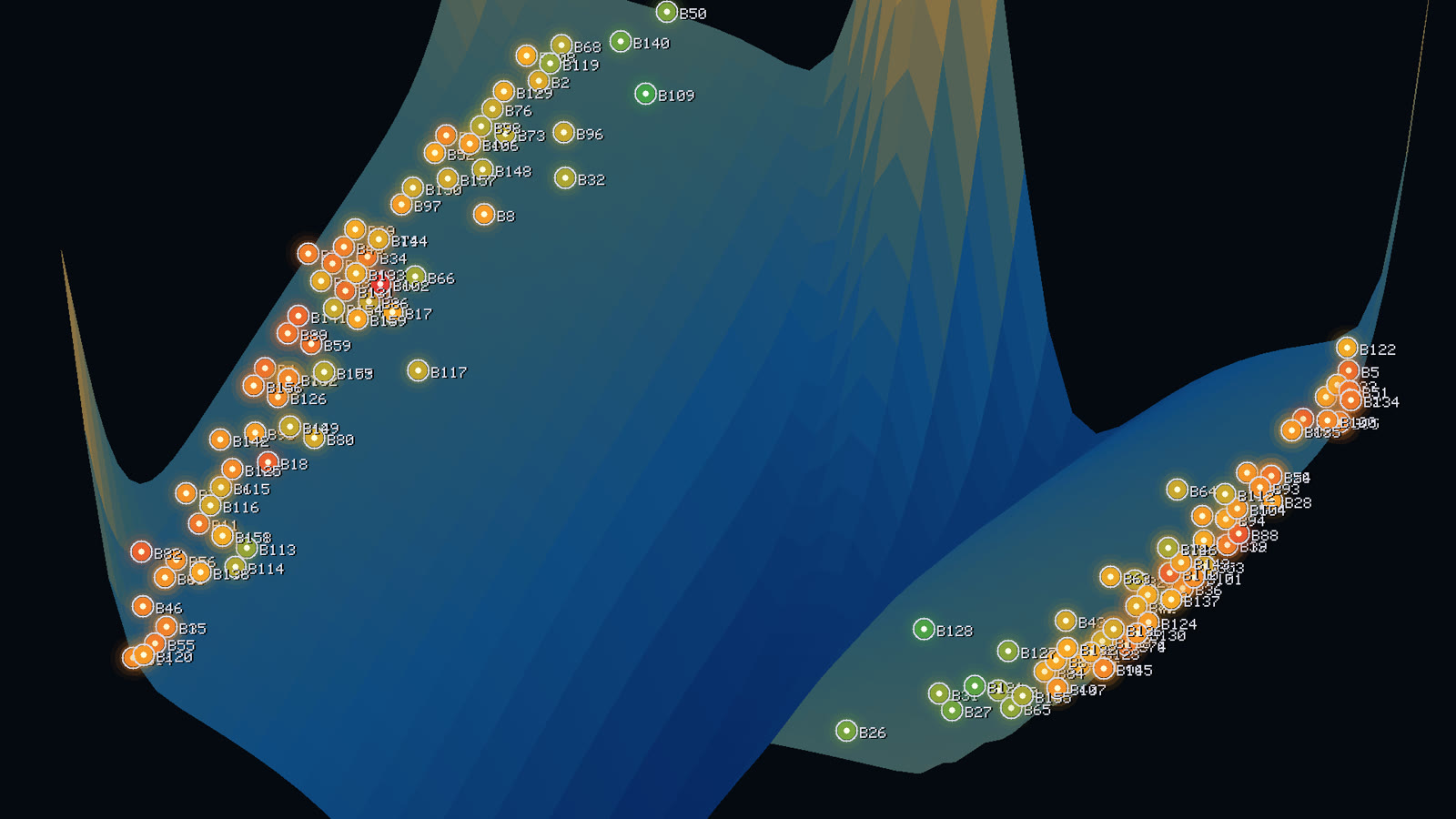
The explanation is part of the computation.
Most explainability tools interpret a model from the outside, after the answer already exists. HLM is built on energy-based (Hopfield) memory: inference settles into a stable state, and the path it took is recorded with the answer.
That makes review a property of the system rather than a reporting exercise. Operators, auditors and customers look at the same record the model produced.
What it does.
Reasoning, recorded
The record of how an answer was reached comes from the same process that produced it.
Uncertainty, built in
Ambiguous, costly or irreversible cases go to a person instead of being treated as certain.
Change without retraining
Energy Language edits one behaviour directly. Validate the change, keep it, or revert it exactly.
How it works.
Bring the evidence
Documents, images, audio, telemetry or 3D data, whatever the decision depends on.
Reason with uncertainty
HLM reaches an answer and states how certain it is.
Review and replay
The answer, its evidence and its review status go into your workflow, ready to replay.
GPU hours on Leonardo, through the EuroHPC AI Factory
Parameters in HLM5-3B Base, public on Hugging Face
Models in the HLM family, from language to edge devices
At a glance.
- Model family
- HLM5 for language; HLM-Vision, HLM-Spatial and HLM-Audio; HLM-Micro and HLM-Nano for edge devices; HLM-Critical, built on your own data.
- Inputs
- Text, documents, images, audio, 3D and sensor streams.
- Deployment
- Your servers, your private cloud, air-gapped sites or embedded devices.
- Change control
- Energy Language: targeted, testable and reversible edits to model behaviour.
- Access
- Controlled early access. HLM5-3B Base is public on Hugging Face.